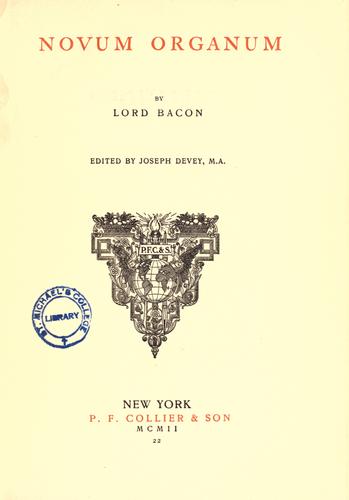
Novum organum
Francis Bacon
Summary (Spoiler-Free)
In 'Novum Organum,' Francis Bacon presents a groundbreaking exploration of the scientific method and empirical research, challenging the established philosophies of his time. This seminal work aims to redefine the ways in which knowledge is acquired and understood, advocating for a systematic approach to investigation and experimentation. Bacon's insights into the nature of knowledge and the importance of observation lay the groundwork for modern scientific thought, making this text a pivotal contribution to philosophy and science.
Who Should Read This
If you have a keen interest in the foundations of scientific inquiry and enjoy philosophical debates about knowledge and understanding, 'Novum Organum' is a must-read. Its thought-provoking arguments will resonate with those who appreciate the evolution of ideas that shaped the modern world.
Frequently Asked Questions
What is the reading order for 'Novum Organum' within philosophical literature?+
'Novum Organum' is a standalone work by Francis Bacon and does not belong to a series. However, it can be beneficial to read it alongside other philosophical texts from the early modern period to appreciate its context and influence. Some readers choose to explore Bacon's other writings, such as his essays, to gain a broader understanding of his thought process, but it is not necessary for grasping the concepts in 'Novum Organum.'
Is 'Novum Organum' suitable for all audiences?+
While 'Novum Organum' is a classic work of philosophy, it may be best suited for readers who have an interest in philosophical discourse, science, or the history of ideas. The text employs a formal style characteristic of its time, which can be challenging for modern readers. It is recommended for those who have some background in philosophy or a willingness to engage deeply with complex ideas. Students, scholars, and those curious about the development of scientific thought will find it particularly rewarding.
Are there any adaptations or formats available for 'Novum Organum'?+
'Novum Organum' has been published in various formats, including print, eBook, and audiobook versions. While there are no major film adaptations of the work, its themes and ideas have influenced many modern discussions in philosophy and science, which can be found in lectures and documentaries. Audiobooks are an excellent option for those who prefer to absorb classical literature through listening, as they often feature interpretations by knowledgeable narrators who can help elucidate the text's challenging concepts.
What makes 'Novum Organum' distinct in the genre of philosophy?+
'Novum Organum' stands out as a critical turning point in philosophical thought due to its advocacy for empirical research and the scientific method. Unlike many of its predecessors, which relied heavily on deductive reasoning and established authorities, Bacon promotes a new approach rooted in observation and experimentation. This work is often seen as a cornerstone of the Enlightenment and marks a shift toward modern scientific inquiry, setting itself apart from earlier philosophical traditions that did not prioritize empirical evidence.
What type of reader is most likely to enjoy 'Novum Organum'?+
Readers who are drawn to deep philosophical inquiry, the evolution of scientific thought, and the interplay between knowledge and practice will likely find 'Novum Organum' engaging. Those with an interest in the historical context of philosophy and science, as well as individuals who appreciate works that challenge conventional thinking, will resonate with Bacon's arguments. This book appeals to both academic readers and casual enthusiasts who enjoy exploring foundational ideas that have shaped modern intellectual landscapes.
Similar Books You'll Love

0.0(0 ratings)
Rate this book:
Book at a Glance
~5 hr 9 min to read
- Pages
- 290
- First published
- 1620
- Original language
- EN