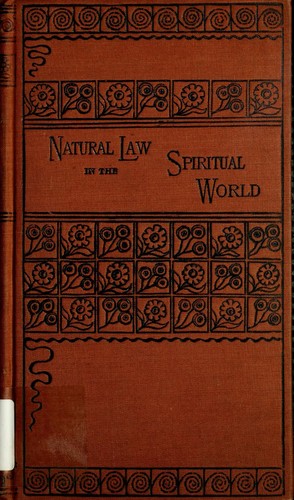
Natural law in the spiritual world
Henry Drummond
Summary (Spoiler-Free)
In 'Natural Law in the Spiritual World,' Henry Drummond explores the connections between the natural laws governing the physical universe and the spiritual principles that shape human experience. He delves into how these laws interact, offering insights into morality, faith, and the human condition. Drummond's work serves as a bridge between science and spirituality, encouraging readers to reconsider their understanding of both realms in the context of a unified existence.
Who Should Read This
If you find yourself intrigued by the intersections of science and spirituality, this book offers profound insights that might resonate with your quest for deeper understanding. It's ideal for readers who appreciate philosophical explorations that challenge conventional boundaries.
Frequently Asked Questions
Is 'Natural Law in the Spiritual World' part of a series or a standalone work?+
This book is a standalone work, meaning it does not belong to any series. Readers can approach it independently, without the need to read prior or subsequent volumes. Henry Drummond’s exploration of natural law in relation to spiritual themes is self-contained, making it accessible for those interested in philosophy without needing background knowledge from other texts.
What audience is this book appropriate for, and are there any content notes I should be aware of?+
This book is primarily aimed at readers with an interest in philosophy, spirituality, or the interplay between science and faith. It is suitable for mature teens and adults, as the themes explored can be complex and may require a certain level of reflective thinking. While the content is thoughtful and profound, it does not delve into graphic or troubling material, focusing instead on intellectual and philosophical discussions.
Are there any adaptations of this book available, such as audiobooks or films?+
Currently, 'Natural Law in the Spiritual World' does not have any widely recognized adaptations into film or television. However, it is available in various formats, including print and digital editions. Audiobook versions may also be available, depending on the publisher, allowing listeners to engage with Drummond's ideas through an audio format.
What makes this book distinct within its genre of philosophy?+
Henry Drummond’s work stands out in philosophy due to its unique approach of merging scientific principles with spiritual insights. Rather than treating these domains as separate entities, he emphasizes their interconnectedness, offering a compelling argument for understanding life through both lenses. This synthesis makes the book particularly engaging for readers who seek a holistic view of existence, blending empirical observation with metaphysical reflection.
What kind of reader tends to enjoy this book the most?+
Readers who are drawn to philosophical inquiries and enjoy exploring the deeper meanings of existence are likely to appreciate this work. Those with a curiosity about how natural laws apply to spiritual beliefs and moral questions will find Drummond’s perspectives stimulating. Additionally, individuals who have an interest in the dialogues between science and spirituality will resonate with the themes presented in the book.
Similar Books You'll Love

0.0(0 ratings)
Rate this book:
Book at a Glance
~6 hr 56 min to read
- Pages
- 391
- First published
- 1835
- Original language
- EN