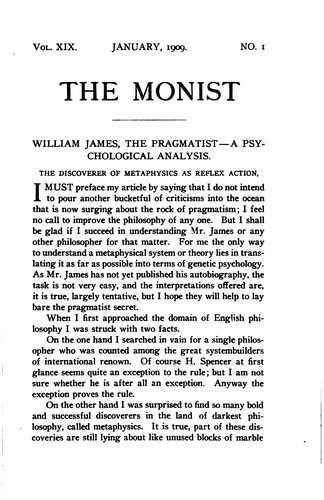
The Monist
Hegeler Institute
Summary (Spoiler-Free)
Published in 1890, 'The Monist' is a profound exploration of philosophical thought that delves into the interconnectedness of various disciplines, including science, religion, and ethics. The book emphasizes a unified view of reality, encouraging readers to reconsider traditional boundaries between fields of knowledge. With its rigorous argumentation and reflective tone, it invites deep contemplation about the nature of existence and our place within it.
Who Should Read This
If you find yourself captivated by the intricacies of philosophical discourse and enjoy wrestling with complex ideas, 'The Monist' could be a compelling read for you. Its in-depth examination of unity in knowledge appeals to those who thrive on intellectual challenges.
Frequently Asked Questions
Is 'The Monist' part of a series, and can it be read as a standalone work?+
'The Monist' is a standalone work, meaning it is not part of a series and can be enjoyed independently. Readers can fully engage with its themes and ideas without needing to read any other texts. This independence allows for a focused exploration of its philosophical concepts, making it accessible to newcomers and seasoned philosophers alike.
What age group or audience is 'The Monist' appropriate for?+
'The Monist' is best suited for adult readers and those with a keen interest in philosophy. Given its complex themes and in-depth discussions, it may not be ideal for younger audiences or those unfamiliar with philosophical discourse. Readers with a background in philosophy or a strong curiosity about existential questions will likely find the material engaging and thought-provoking.
Are there any adaptations of 'The Monist' available, such as audiobooks or film versions?+
As of now, 'The Monist' remains primarily in print format, and there are no known film adaptations or widely available audiobooks. However, its historical importance and philosophical insights continue to inspire discussions and analyses within academic circles, ensuring that its legacy remains vibrant even without modern adaptations.
What sets 'The Monist' apart from other philosophical works?+
'The Monist' distinguishes itself by its commitment to the idea of a unified philosophical perspective that transcends traditional academic boundaries. The text invites readers to engage with a holistic understanding of knowledge, challenging the compartmentalization often found in philosophical literature. This integrative approach encourages a multidisciplinary dialogue, making it a unique contribution to the field.
What type of reader is likely to enjoy 'The Monist' the most?+
Readers who are drawn to philosophical inquiry and enjoy engaging with challenging ideas will likely find 'The Monist' particularly rewarding. Those with an appreciation for deep, analytical thinking and a desire to explore the intersections of various fields—such as science, ethics, and spirituality—will resonate with its content. This book appeals to intellectual explorers eager to expand their understanding of the world.
Similar Books You'll Love

0.0(0 ratings)
Rate this book:
Book at a Glance
~11 hr 42 min to read
- Pages
- 660
- First published
- 1890
- Original language
- EN