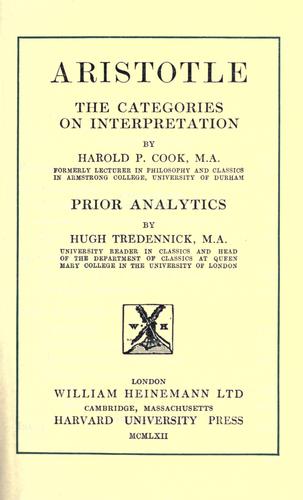
Organon
Aristotle
Summary (Spoiler-Free)
In 'Organon,' Aristotle presents a foundational work in the field of logic and philosophy, exploring the principles of reasoning and the structure of arguments. This collection of texts delves into concepts such as syllogism, deduction, and the nature of knowledge, laying the groundwork for future philosophical inquiry. Through meticulous analysis and clear exposition, Aristotle seeks to elucidate the methods by which we arrive at truth and understanding. The tone is both rigorous and accessible, inviting readers to engage deeply with philosophical thought.
Who Should Read This
If you have a passion for exploring the intricacies of logic and the philosophical underpinnings of knowledge, 'Organon' is a must-read. This work is particularly suited for those who enjoy grappling with complex ideas and appreciate the historical context of philosophical discourse.
Frequently Asked Questions
What is the reading order for 'Organon' within Aristotle's works?+
Although 'Organon' is a standalone work, it is often beneficial to approach it with some familiarity of Aristotle’s other key texts. It is generally advisable to read it after engaging with texts like 'Nicomachean Ethics' or 'Metaphysics,' which provide a broader context for his philosophical ideas. However, 'Organon' can also serve as an entry point into Aristotle's thought, particularly for those interested in logic and epistemology. Since it's a collection, readers might choose to focus on specific parts based on their interests, like Prior Analytics for syllogistic logic or Posterior Analytics for principles of scientific reasoning.
Is 'Organon' appropriate for all audiences?+
'Organon' is primarily aimed at readers with an interest in philosophy, logic, and critical thinking. While it is accessible, some sections may be challenging for those unfamiliar with philosophical terminology or concepts. It's best suited for college students, scholars, or avid readers of philosophy. Content-wise, the book does not contain graphic material, focusing instead on intellectual discourse, making it appropriate for mature high school students and above who are prepared for rigorous academic engagement.
Are there any adaptations or alternative formats available for 'Organon'?+
'Organon' has been translated into various languages and is available in multiple formats, including paperback, hardcover, and digital editions. Audiobook formats may vary, but many modern translations are accessible in audio form to cater to diverse audiences. Additionally, certain academic courses may feature lectures or discussions based on 'Organon,' providing an alternative means of engaging with the text. However, there are no major film adaptations, as the work is largely theoretical and best suited for the reading experience rather than visual storytelling.
What sets 'Organon' apart from other philosophical texts?+
'Organon' stands out in the realm of philosophy due to its foundational exploration of logic, which has influenced centuries of thought in both philosophy and science. Aristotle's systematic approach to syllogistic reasoning and argumentation provides a clear framework that has been pivotal in the development of formal logic. Unlike some philosophical works that may focus on abstract concepts or metaphysics, 'Organon' is grounded in practical methodologies for reasoning, making it a distinct and essential read for those interested in the mechanics of thought and analysis.
What type of reader is likely to enjoy 'Organon'?+
Readers who thrive on intellectual challenges and enjoy deep philosophical inquiry will likely find 'Organon' engaging. Those with a background in or a curiosity about logic, science, and epistemology will appreciate Aristotle's insights and methodical approach. Additionally, students of philosophy, educators, and anyone interested in the evolution of critical thinking will benefit from the text’s analytical depth and historical context. If you enjoy dissecting arguments and understanding the principles behind reasoning, 'Organon' will resonate with you.
Similar Books You'll Love
0.0(0 ratings)
Rate this book:
Book at a Glance
~2 hr 35 min to read
- Pages
- 146
- First published
- 1481
- Original language
- EN