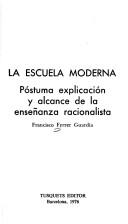
La escuela moderna
Francisco Ferrer Guardia
Summary (Spoiler-Free)
In 'La escuela moderna,' Francisco Ferrer Guardia presents a revolutionary vision for education that emphasizes freedom, creativity, and critical thinking. Written in the early 20th century, this foundational text challenges traditional pedagogical methods, advocating for a secular and progressive educational approach. Ferrer's ideas encourage learners to engage actively with their surroundings and develop an independent mindset, laying the groundwork for modern educational reforms.
Who Should Read This
This book is perfect for readers who are passionate about education reform and philosophical discussions surrounding pedagogy. If you're intrigued by the intersection of education and social change, Ferrer's insights will resonate deeply with you.
Frequently Asked Questions
What is the significance of 'La escuela moderna' in the context of educational philosophy?+
'La escuela moderna' is a landmark work that critiques traditional educational systems and proposes a new model focused on student engagement and autonomy. Ferrer advocates for a secular education free from dogma, which was a radical idea for his time. His philosophy emphasizes critical thinking and personal development over rote memorization, making it a key text for anyone interested in the evolution of educational thought.
Is 'La escuela moderna' suitable for all age groups or specific audiences?+
While the book is primarily aimed at educators, philosophers, and those interested in sociopolitical issues, its concepts can be appreciated by a broader audience. However, readers should be aware that the text is rooted in early 20th-century philosophy and may require some background knowledge in educational theory to fully grasp its implications.
Are there any adaptations of 'La escuela moderna' in other formats, such as audiobooks or films?+
As of now, 'La escuela moderna' remains primarily available in print format, with limited availability in digital formats. While there may not be any direct adaptations into film or audiobooks, the ideas presented in the book continue to influence contemporary discussions in education and philosophy, which may lead to various interpretations or discussions in other media.
How does 'La escuela moderna' compare to contemporary educational literature?+
'La escuela moderna' stands out in its genre due to its early advocacy for progressive education principles that resonate with current debates surrounding student-centered learning. Ferrer's emphasis on creativity and critical thought foreshadows many contemporary approaches to education, making the book not only relevant but also a historical precursor to modern theories on teaching and learning.
What type of reader is most likely to enjoy 'La escuela moderna'?+
Readers who are drawn to philosophical discussions about education and social reform will find 'La escuela moderna' particularly compelling. Those who appreciate historical texts that challenge conventional wisdom and advocate for progressive change will likely enjoy Ferrer's thought-provoking ideas, as well as educators seeking inspiration to innovate their teaching practices.
Similar Books You'll Love
0.0(0 ratings)
Rate this book:
Book at a Glance
~4 hr 43 min to read
- Pages
- 266
- First published
- 1910
- Original language
- EN