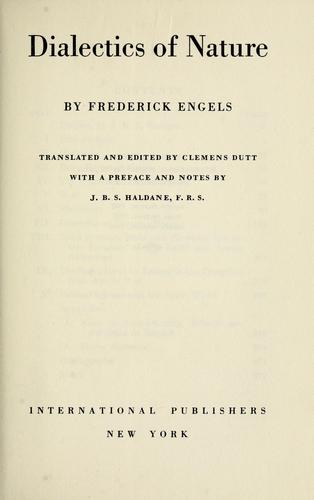
Dialektik der Natur
Friedrich Engels
Summary (Spoiler-Free)
In 'Dialektik der Natur', Friedrich Engels explores the interconnectedness of nature and society through a philosophical lens. He delves into the principles of dialectical materialism, emphasizing the importance of understanding natural processes to fully grasp human development. With a focus on the scientific underpinnings of nature, this work invites readers to reconsider their relationship with the world around them. Engels' thought-provoking insights challenge conventional views, making this a significant contribution to both philosophy and natural science.
Who Should Read This
If you have a keen interest in philosophy and the interplay between nature and society, this book might resonate deeply with you. Readers who appreciate critical thinking and the application of dialectical reasoning will find Engels' arguments particularly compelling.
Frequently Asked Questions
Is 'Dialektik der Natur' part of a series or is it a standalone work?+
'Dialektik der Natur' is a standalone work by Friedrich Engels. It stands alone in its exploration of philosophical ideas related to nature and society, rather than being part of a series. Readers can approach it independently without needing to read other texts by Engels or related authors to fully appreciate its insights.
What is the appropriate audience for this book? Are there any content notes?+
'Dialektik der Natur' is primarily aimed at readers with an interest in philosophy, particularly those who are keen on Marxist theory and dialectical materialism. It contains complex ideas and terminology that may be challenging for casual readers or those unfamiliar with philosophical discourse. While the content is intellectually stimulating, it may not be suitable for younger audiences or those seeking light reading, as its themes require a thoughtful engagement with the material.
Are there any adaptations or different formats available for this book?+
'Dialektik der Natur' is available in various formats, including print and digital editions. Audiobook versions may also be accessible for listeners who prefer audio formats, though availability can vary. As for film adaptations or theatrical interpretations, none are widely recognized, as Engels' work is primarily academic and philosophical in nature, focusing more on intellectual discourse than narrative storytelling.
What makes 'Dialektik der Natur' distinct within its genre?+
'Dialektik der Natur' stands out in the philosophy genre due to its unique blend of scientific inquiry and philosophical analysis. Engels approaches natural phenomena through the lens of dialectical materialism, providing readers with a perspective that integrates both science and philosophy. This fusion allows for a deeper understanding of how natural processes influence and reflect human society, making it a notable contribution to philosophical thought and a critical examination of the material world.
What kind of readers are likely to enjoy this book?+
Readers who are drawn to philosophical exploration, particularly those interested in Marxist theory and social critique, will likely find 'Dialektik der Natur' engaging. Individuals who appreciate rigorous analysis and the application of dialectical thought to both natural and societal issues will resonate with Engels' arguments. If you enjoy works that challenge conventional wisdom and encourage critical reflection on the relationship between humanity and the natural world, this book is likely to appeal to you.
Similar Books You'll Love

0.0(0 ratings)
Rate this book:
Book at a Glance
~7 hr 9 min to read
- Pages
- 403
- First published
- 1940
- Original language
- EN